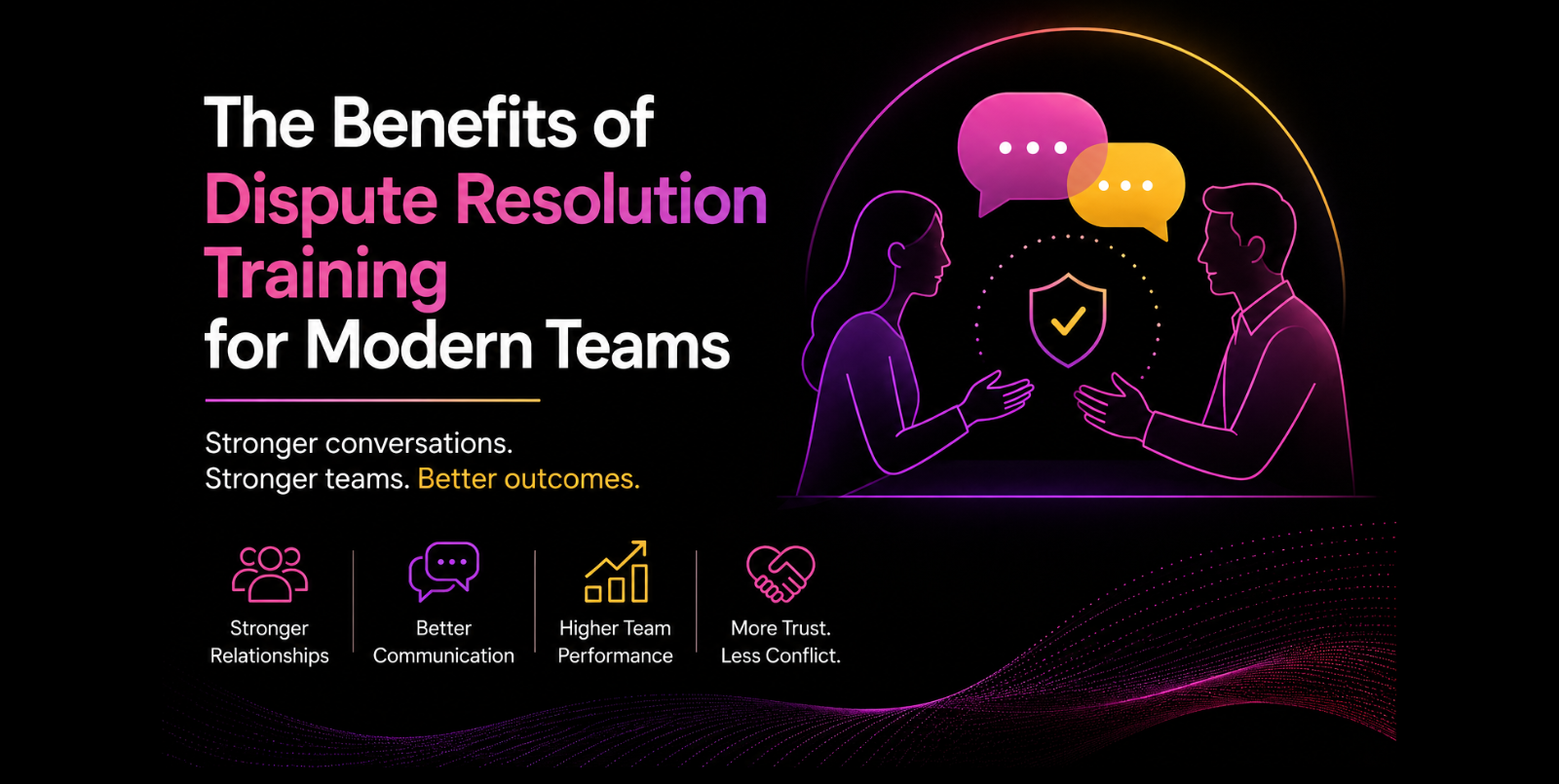
The Benefits of Dispute Resolution Training for Modern Teams

Meg Smith
May 6, 2026
Conflict is inevitable whenever people work together. Different personalities, competing priorities, communication breakdowns, and high-pressure environments make disagreement a natural part of team dynamics. The issue is not whether conflict will happen - it’s how conflict is handled when it does.
Without the right skills, even minor disagreements can escalate into major disruptions. That’s why more organizations are investing in dispute resolution training. When teams know how to navigate conflict productively, they communicate better, collaborate more effectively, and maintain momentum even when tensions rise.
In most any environment where people work toward shared goals, dispute resolution is no longer just a “nice-to-have” skill. It’s a competitive advantage.
What Is Dispute Resolution Training?
Dispute resolution training teaches individuals and teams how to manage disagreements constructively and move difficult conversations toward productive outcomes. Rather than avoiding conflict or reacting emotionally, individuals learn how to:
Address issues directly and professionally
De-escalate tension
Identify underlying interests and concerns
Communicate clearly during disagreement
Collaborate on solutions that work for everyone involved
At its core, dispute resolution training helps people replace reactive habits with intentional communication strategies.
Why Modern Teams Need Dispute Resolution Training More Than Ever
Today’s teams face more communication complexity than ever before. They are more remote or hybrid, and more cross-functional. They are also more diverse in communication styles and perspectives than ever. Faster and tighter deadline requirements create constant change and uncertainty.
All of that increases the likelihood of conflict. And when teams lack dispute resolution skills, conflict often leads to situations like:
Miscommunication
Frustration
Delayed projects
Damaged trust
Lower morale
Employee disengagement
The cost of unresolved conflict can add up quickly. Dispute resolution training helps teams prevent small issues from becoming bigger organizational problems.
Better Conflict Management Improves Team Performance
One of the biggest misconceptions about workplace conflict, in particular, is that eliminating disagreement should be the goal. It shouldn’t. Healthy disagreement often leads to better ideas, stronger decision-making, innovation, and greater personal accountability.
The problem is not typically conflict itself. The problem is unproductive strategies for resolving them. Dispute resolution training helps teams engage in disagreement without letting it derail relationships or performance.
When team members know how to navigate conflict well, they are more likely to:
Speak up when problems arise
Challenge ideas constructively
Collaborate through tension
Stay focused on solutions rather than blame
That creates stronger, more resilient teams.
Dispute Resolution Training Strengthens Leadership at Every Level
Conflict management is often viewed as a leadership responsibility. There is good reason for that. Leaders set the tone for how disagreement is handled.
But modern organizations increasingly recognize that dispute resolution should not live solely with managers or HR. The most effective teams empower everyone with conflict resolution skills. Why? Because conflict happens everywhere:
Between peers
Across departments
With clients or customers
In project teams
During feedback and performance conversations
When only leadership knows how to handle conflict, bottlenecks form and productivity suffers. When entire teams are trained, conflict can be addressed earlier, faster, and more effectively.
Dispute Resolution Training Builds Trust and Psychological Safety
Trust is essential to team performance. But trust doesn’t come from avoiding difficult conversations, it comes from knowing your team can handle them effectively. When people trust that conflict will be addressed respectfully, they are more likely to:
Speak honestly
Share concerns early
Offer feedback openly
Raise disagreements without fear
Participate fully in collaboration
Dispute resolution training helps create this kind of environment. It gives teams shared tools and language for navigating tension productively. The result is stronger psychological safety and healthier communication overall.
It Reduces Turnover and Burnout
Poorly managed conflict is one of the most common drivers of workplace dissatisfaction. People rarely leave jobs because of a single disagreement. They leave because of repeated patterns like:
Unaddressed tension
Passive-aggressive communication
Challenging interpersonal dynamics
Feeling unheard or unsupported
Constant friction with colleagues or leadership
Dispute resolution training helps interrupt these patterns before they damage retention and morale. When employees feel equipped to address issues, and are confident their concerns will be handled constructively, they are far more likely to remain engaged.
It Helps Teams Move Faster
Many organizations assume conflict slows teams down. In reality, unresolved conflict slows teams down. It’s not the conflict itself. When issues are left unaddressed:
Decisions get delayed
Resentment builds
Collaboration suffers
Communication becomes indirect
Productivity declines
Dispute resolution training helps teams address issues quickly and directly, reducing friction and helping projects move forward with less disruption. In fast-moving organizations, that efficiency matters.
Why Traditional Dispute Resolution Training Often Falls Short
Like many communication-based skills, dispute resolution is frequently taught in overly theoretical ways. Participants attend workshops, review frameworks, and discuss hypothetical scenarios. Learning frameworks and theory is important, but it can never replace practice. Individuals often return to work and struggle to apply those lessons when emotions run high.
Why? Because conflict resolution is a performance skill. And performance skills require practice. You cannot become better at navigating difficult conversations simply by learning concepts. You improve by doing.
The Missing Piece: Practice in Realistic Conflict Scenarios
To build real dispute resolution skills, people need opportunities to practice:
Handling emotional responses
Navigating pushback
Managing defensiveness
Staying calm under pressure
Reframing difficult conversations in real time
This is where most training programs stop short. They teach what to do, but don’t provide enough realistic repetition to make those behaviors instinctive. Without practice, people revert to old habits when conflict becomes uncomfortable.
How Empathic Edge Makes Dispute Resolution Training More Effective
Empathic Edge was built to close the gap between knowing conflict resolution principles and actually applying them under pressure. Through realistic, AI-powered conversation role play scenarios, users can practice:
Resolving interpersonal disputes
Managing team tension
Delivering difficult feedback
Navigating emotionally charged conversations
Handling disagreements with confidence
These role play scenarios allow users to:
Experiment with different approaches
Receive feedback on communication style
Build emotional regulation under pressure
Strengthen perspective-taking and empathy
Practice until productive conflict habits become second nature
Because teams do not improve conflict resolution by reading about it. They improve by practicing it. Now, Empathic Edge provides a platform where anyone can practice these skills, anywhere, anytime.
Who Benefits From Dispute Resolution Training?
Dispute resolution training is valuable across nearly every team and organization, including:
Leadership Teams: Improve alignment and accountability
HR Professionals: Support healthier workplace dynamics
Project Teams: Reduce friction and improve collaboration
Sales Teams: Navigate client disagreements effectively
Customer Service Teams: Handle conflict professionally
Educators and Administrators: Resolve issues constructively
Legal and Professional Services: Improve client and internal communication
If people work together, dispute resolution matters.
The Future of Team Development Is Practice-Based
Organizations are rethinking how communication skills are developed. Instead of relying solely on lectures and workshops, the future of dispute resolution training is:
Interactive
Practice-based
Scenario-driven
Personalized
Repeatable
Teams need more than theory. They need opportunities to rehearse for real conflict before it happens. That is how durable communication skills are built.
With the right dispute resolution training, teams can transform conflict from a source of disruption into a driver of growth, innovation, and stronger collaboration. When people know how to navigate disagreement productively, trust increases, performance improves, and teams become more resilient.
And with modern practice-based platforms like Empathic Edge, building those skills is more accessible than ever.
Ready to Strengthen Your Team’s Conflict Resolution Skills?
Empathic Edge helps professionals and teams practice real-world conflict scenarios through AI-powered role play scenarios that build confidence, empathy, and communication under pressure.
Try it for free today and see how modern dispute resolution training can transform the way your team handles conflict.
Meg Smith
Founder, Empathic Edge
Meg is a licensed attorney, certified mediator, and educator with years of experience helping people navigate high-stakes conversations. She founded Empathic Edge to make practical negotiation and communication skills accessible to everyone — from law students preparing for the bar to professionals navigating workplace challenges.
Featured Articles

The Skill Gap Nobody Talks About: Why Communication Skills Training Needs Practice
Effective communication requires more than knowing the right techniques. Explore why communication skills training benefits from realistic practice to help students and professionals build skills they can use when conversations matter most.

Why Smart People Are Often the Worst Listeners
Being smart and experienced doesn't always make us better listeners. In this blog, Meg Smith explores the difference between listening to confirm and listening to discover, and why curiosity can lead to better conversations and outcomes.

Empathic Edge Enters a New Chapter: Design Partnerships Bring AI-Powered Practice Into the Classroom
Empathic Edge is entering a new chapter with Design Partnerships that bring AI-powered simulations into law school classrooms, clinics, and advocacy programs. These partnerships give students more opportunities to practice the skills they need in real-world conversations.
Ready to Put These Ideas Into Practice?
Try Empathic Edge and practice a conversation that matters to you.